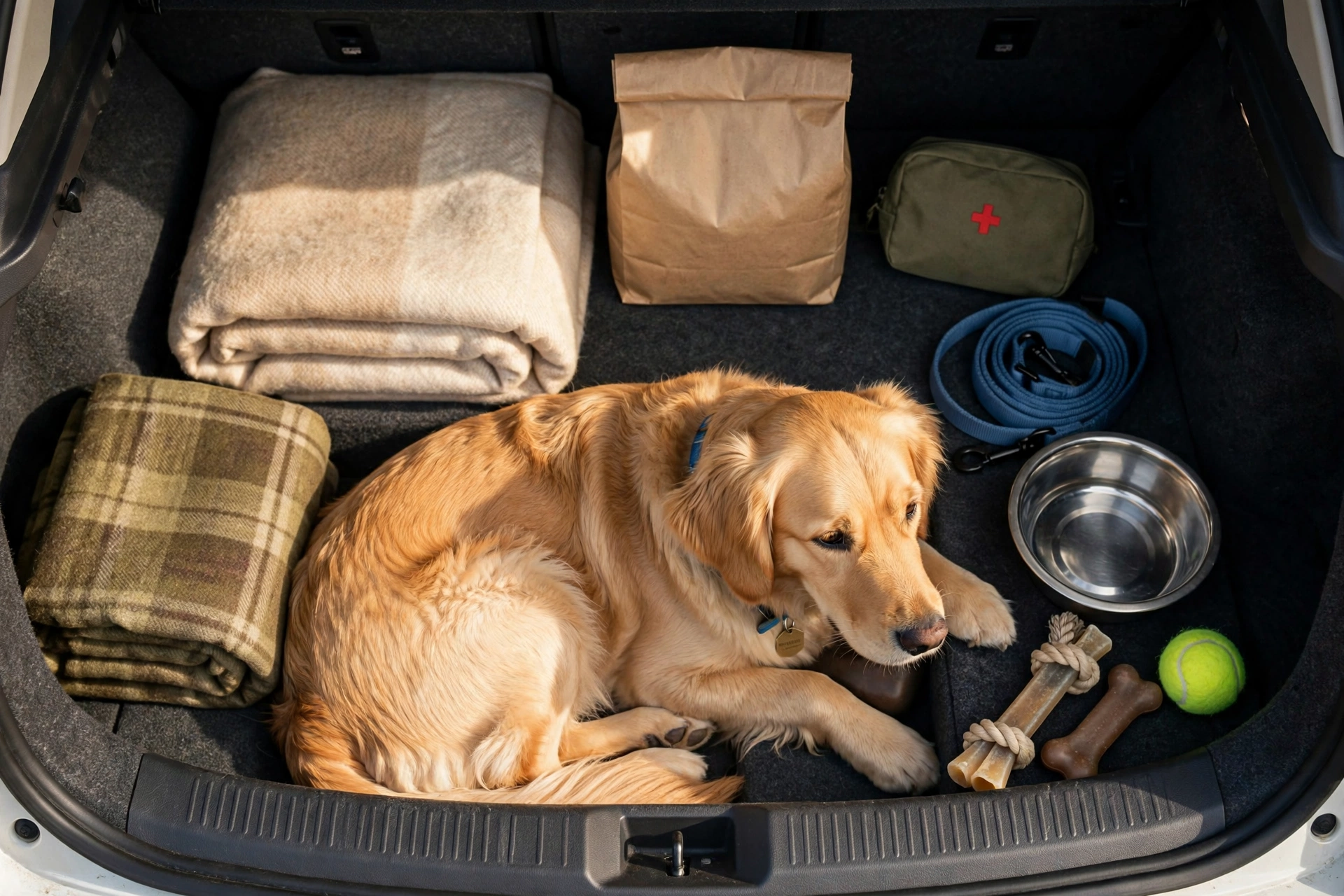
Start with the dog in front of you
Every packing list assumes a medium-sized, bombproof Labrador. Yours might be a shivering whippet, a car-sick spaniel puppy, or a fourteen-year-old who needs a ramp and a warm bed. Before you open the boot, ask three questions: how does my dog cope with new places, what does the weather do to them, and what can’t be replaced if forgotten? A nervous rescue needs their own unwashed blanket more than any gadget. Medication — daily tablets, allergy treatment, vet-approved calming aids — goes at the very top.
The non-negotiables: food, water, lead — and the law
In Britain a dog in a public place must wear a collar showing the owner’s name and address — the Control of Dogs Order 1992 still applies, and a phone number on the tag is what gets a lost dog home. Microchipping is compulsory too, but it supplements the tag. Pack a spare lead; leads get chewed, snap, or get left looped around a café chair two counties back. Bring the whole trip’s food plus two spare days, sealed with its label — if your dog reacts to something, you’ll want the exact recipe for the vet. Keep a filled water bottle and bowl in the car, and a few litres from home for day one if stomachs are sensitive.
- Collar with name, address and phone number on the tag
- Everyday lead plus one spare, and a long line for safe sniffing
- Full trip’s food plus two days, with the original label
- Water bottle, travel bowl and plenty of poo bags
- The dog’s own bed or blanket, unwashed
Set the car up for a calm dog
Highway Code Rule 57 requires animals to be suitably restrained — a crash-tested crate secured in the boot is the gold standard; on a back seat, use a crash-tested harness on a seatbelt anchor, never a collar, plus a seat cover against wet-dog smell. Add a familiar blanket, a chew for the first hour, and ventilation that doesn’t blast cold air at the dog. Stop every two hours for stretching, water and toilet breaks. And the rule needing no explanation: never leave a dog alone in a car on a warm day, not even briefly.
Walks and weather: the British outdoors kit
A drying coat — the towelling-robe kind — is the most useful dog garment for a British holiday: soaked spaniel to car-ready in twenty minutes. Pack twice the towels you expect, plus an old blanket for accommodation floors. Bring paw balm for hot pavements and coastal paths, and a tick remover — ticks are widespread in grassland and woodland from spring to autumn. A clip-on light keeps dark-coated dogs visible on unlit lanes, and a long line gives sniffing freedom in livestock country without the risk of a chase.
Paperwork, health and the vet’s number
Keep your vet’s number, insurance details and microchip number in one place. Bring the prescription label or a vet’s letter for any medication — a new vet asked to dispense at short notice will want proof. Before you leave, save the address of one emergency vet near your destination; the RCVS “find a vet” tool covers the whole country, and a two-minute search from the sofa beats a panicked one at 11pm. If you travel with a first-aid kit, our first-aid kit guide covers what goes in it and when to stop treating and drive.
Pack it so you can reach it
One grab bag holds the journey essentials — water, bowl, lead, treats, poo bags, medication, towel — on the back seat or just inside the boot; everything else can go deep. Do a ten-minute trial pack the weekend before a long trip: you’ll discover the crate doesn’t fit alongside the cool box while there’s still time to fix it.
What you can leave behind
Leave the bulk-buy treats — a pouch refilled from the food bag does the job. Leave duplicate toys; one or two favourites beat a toy box ignored in a new place. Britain is dense with pet shops, supermarkets and vets: medication, the right food and paperwork are the irreplaceable items. Get those right and the rest is solvable.
Packing questions, answered
Packing questions, answered
Is a collar tag legally required in the UK?
Yes. The Control of Dogs Order 1992 requires a dog in a public place to wear a collar with the owner's name and address — add your phone number, as that's what gets a lost dog home. Microchipping is compulsory too, but it doesn't replace the tag.
How much food should I pack for a week away?
The full trip plus two spare days, pre-portioned if you can. Holiday parks rarely stock your dog's exact food, and a sudden diet change on top of travel stress means an upset stomach.
Crate or harness in the car?
Either, properly fitted: a crash-tested crate secured in the boot, or a crash-tested harness on a seatbelt anchor. Highway Code Rule 57 requires restraint — a loose dog is both a projectile and a distraction.
What if I forget something important?
Prioritise medication, the right food and paperwork — those are genuinely hard to replace. Pet shops, supermarkets and vets are rarely far away in Britain; everything else can be bought.